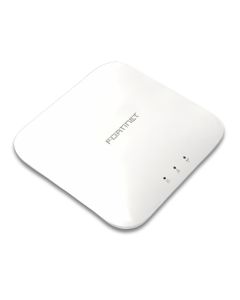
Fortinet FortiAP 241K.
Four radios. One ceiling tile. Wi-Fi 7.
The FortiAP 241K is Fortinet's quad-radio Wi-Fi 7 indoor access point built for high-density enterprise environments.
Three radios serve clients while a dedicated fourth radio scans for rogue devices and interference around the clock, all
managed through any FortiGate, FortiEdge Cloud, or FortiSASE with no separate controller license.
Expert Pre-Sales AdviceCertified reps reply in 1 hour.
Config & Managed ServicesSkip the setup. We'll do it.
POs · Tax-Exempt · Net 30Welcomed for Corp, Edu, & Gov.
Same-Day ShippingOrder by 3pm EST, ships today.
Specifications
FortiAP 241K at a Glance
Wireless Performance
Wi-Fi Standard: Wi-Fi 7 (802.11be) MIMO: 2x2 MU-MIMO with OFDMA on all three bands 2.4 GHz: Up to 688 Mbps 5 GHz: Up to 4,324 Mbps 6 GHz: Up to 5,765 Mbps (320 MHz, 4096-QAM) Aggregate: Up to 10.8 Gbps Clients per radio: Up to 512 SSIDs: Up to 24 simultaneous
Radios and Antennas
Serving Radios: 3 (one each for 2.4, 5, and 6 GHz) Scan Radio: 1 dedicated tri-band radio covering all three bands continuously for WIPS and WIDS without borrowing airtime from clients Internal Antennas: 6 (dual-band, 6 GHz, and tri-band types) External Connectors: 6 RPSMA for optional directional or high-gain antennas BLE / ZigBee: 1 internal antenna for IoT, beacons, and locationing
Ports and Power
Primary Uplink: 1x 10 GbE multigigabit RJ45 (100M / 1G / 2.5G / 5G / 10G) Secondary Port: 1x 1 GbE RJ45 for local device daisy-chain PoE (full): 802.3bt required for all 4 radios at rated power (26.1W max) PoE (high): 802.3at runs all radios, but 6 GHz drops to 15 dBm and USB is disabled PoE (low): 802.3af delivers scan-only mode USB: 1x Type-A 2.0 at 2.5W Console: 1x RS-232 RJ45
Management and Security
Controllers: FortiGate WLAN controller, FortiEdge Cloud, or FortiSASE. No per-AP license for FortiGate management. Zero-Touch: Automatic discovery and provisioning via FortiEdge Cloud for branch deployments without on-site IT WIPS / WIDS: Dedicated scan radio monitors 24/7 without reducing client capacity Authentication: WPA3, WPA2, 802.1X, captive portal, MAC filtering Mounting: Ceiling and wall mount kit included in box
Comparing the 241K with other FortiAP Wi-Fi 7 models?
The 241K sits between the 231K (3-radio, 5 GbE uplink) and the 431K (4x4 MIMO, higher throughput). The 241K is the right choice when you need a dedicated scan radio and a 10 GbE uplink in a 2x2 MIMO footprint. If your deployment needs external antennas instead of internal ones, the 243K is the identical platform with RPSMA connectors in place of the built-in elements.
The 241K and 243K are the same quad-radio Wi-Fi 7 platform with one hardware difference. The 241K uses six internal antennas for a clean ceiling-mount appearance in standard office, classroom, and healthcare deployments. The 243K replaces those with six external RPSMA connectors, letting you attach directional or high-gain antennas for auditoriums, warehouses, or any space with unusual RF geometry. Both models deliver the same throughput, client capacity, and management options, and both ship to North America under the -A region code.
Full 4-radio operation at rated power requires 802.3bt PoE, also called PoE++ or Type 3 or Type 4. The maximum draw is 26.1 watts. For a dedicated injector, Fortinet's GPI-145 is the right choice because it provides a 10 GbE uplink to match the AP's primary port. If your existing switches supply only 802.3at, the AP enters high mode: all three serving radios run, but the 6 GHz radio is limited to 15 dBm transmit power and the USB port is disabled. 802.3af puts the AP into scan-only mode with no client service.
No. The FortiAP 241K runs under FortiEdge Cloud or FortiSASE without a FortiGate on site, which makes it practical for distributed branches where there is no local firewall. If a FortiGate is in the stack, the AP appears automatically in the FortiGate WLAN controller and inherits existing SSIDs and security policies, with no per-AP controller license required. Organizations managing the AP through FortiSASE also receive cloud-delivered ZTNA and secure web gateway functionality alongside the wireless management.
The fourth radio is a tri-band monitor that watches the 2.4, 5, and 6 GHz spectrum continuously for rogue access points, unauthorized clients, and RF interference. Because it is a separate, dedicated radio, the three client-serving radios never have to pause client traffic to do a scan. Most enterprise APs achieve background monitoring by taking time-slices from the serving radio, which cuts effective throughput noticeably in dense environments. On the 241K, security scanning and client service run in parallel at all times, so you get full capacity on all three bands and full WIPS coverage simultaneously.
Yes. Up to 512 clients per radio, 24 simultaneous SSIDs across all bands, and a 10 GbE uplink that absorbs the combined throughput of all three serving radios make it purpose-built for dense floors. The 6 GHz band with 320 MHz channel widths adds substantial clean airtime in locations where 5 GHz is congested from neighboring networks. The AP also supports Multi-Link Operation, which lets compatible Wi-Fi 7 clients bond multiple radio links simultaneously for lower latency and higher effective throughput. Ceiling and wall mount hardware ships in the box, and the AP operates between 0 and 50 degrees Celsius.
Not sure which FortiAP is right for your floor plan?
Tell us the square footage, expected device count per area, and whether you need the 6 GHz band or external antenna flexibility. A certified Fortinet engineer reaches back within one business hour with a model recommendation and a PoE power plan.


Login and Registration Form
Existing User